
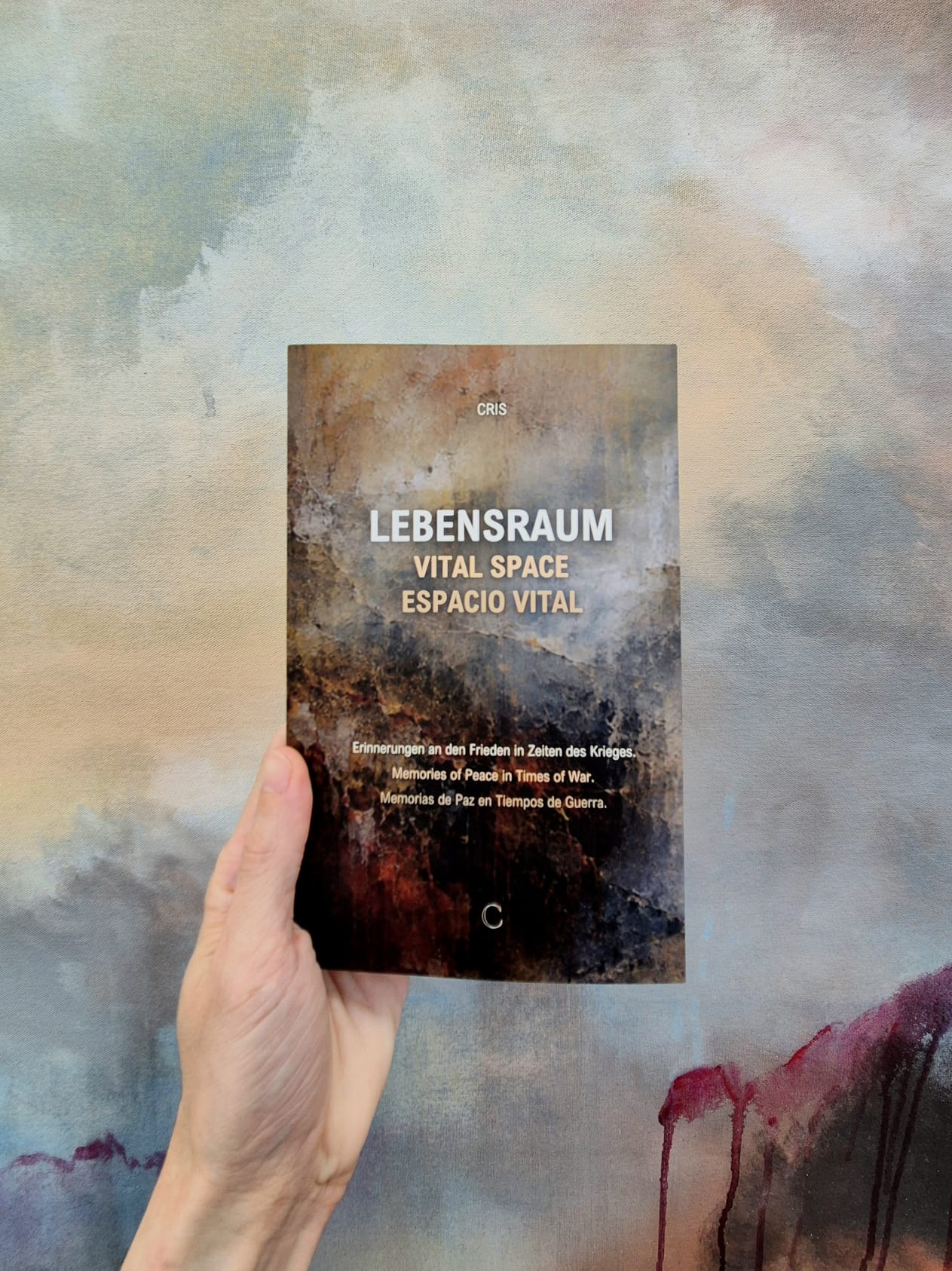
Within the framework of the CAS Art & Peace Postgraduate Program [Certificate of Advanced Studies] offered by the University of Art and Design of Basel, Atelier Mondial and Swisspeace, during Kunsttage Basel held in August 2026 in Basel, Switzerland; Cris presented his thesis, exhibition of final work and new book.
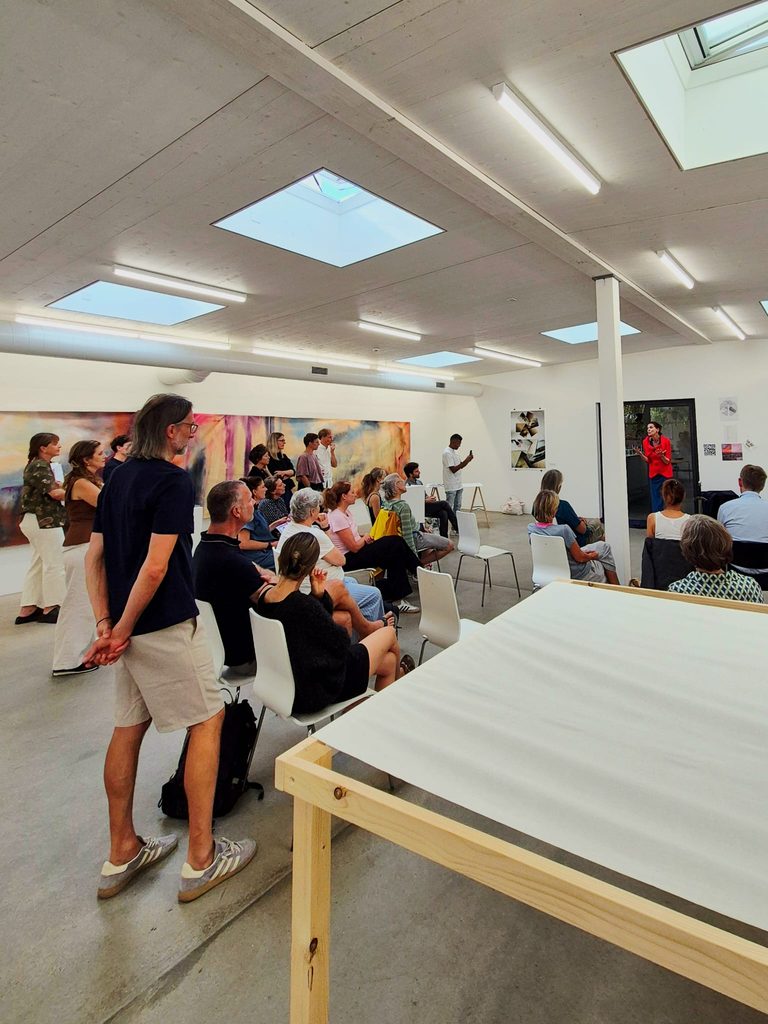
Lebensraum is a transdisciplinary project that links international relations, historical consciousness, and the phenomenology of space. It presents an immersive experience of the peace-war binary through the creation of a “Vital Space of Memory” divided into three stations: a large-format painting, a trilingual poetry book, and a Virtual Reality installation.
The artistic component unfolds through an immersive experience that integrates large-format painting, pictographic language, multilingual poetry, virtual reality, and original music. By weaving these mediums together, the project seeks to materialize space not merely as a geographic coordinate, but as a dimension layered with historical and sensory strata.
The report-thesis provides the theoretical framework for the investigation, exploring the fundamental question at the core of the project: What happens to peace when memory ceases to function as a political boundary against war? Through this inquiry, the research examines how the erosion of collective memory facilitates the normalization of violence and the reconfiguration of territories within the contemporary international order.
Lebensraum is an aesthetic warning: peace does not fail when the bomb explodes, but when the space we inhabit ceases to be safeguarded by collective memory. It is a call to expand the space of peace through art.
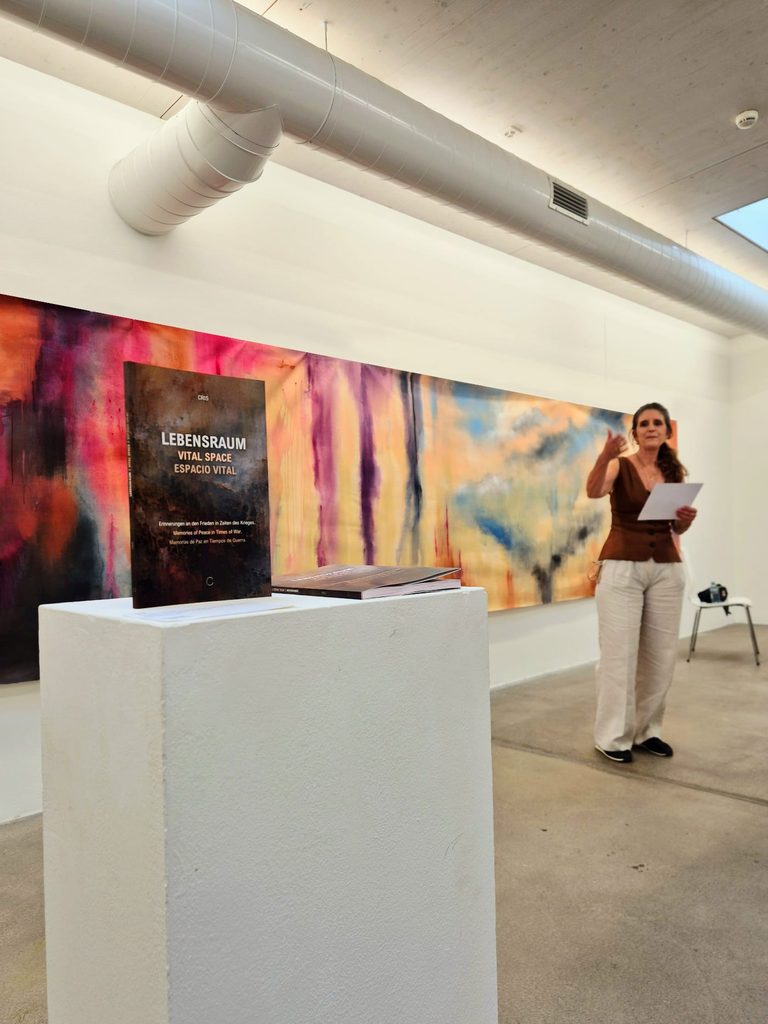
Cris’s new book: “LEBENSRAUM / VITAL SPACE / ESPACIO VITAL: Memories of Peace in Times of War” maps a timeless historical line where the battles of the past, the burning conflicts of today, and the digital threats of tomorrow coexist simultaneously with the search for peace. Cris transforms geopolitics into raw emotion, turning cold war data into an intimate, biological, and visceral witness. This collection is a literary manifesto. A memorial to the earth we inhabit and an active Vital Space of Memory against the madness of war.
Conclusion
The failure of peace in the contemporary international order is not merely a consequence of the outbreak of armed conflict; it is the result of a deeper, systemic collapse rooted in the circular nature of history. Within this eternal recurrence, war and peace have coexisted as permanent and overlapping conditions for inhabiting human space. When the ‘Vital Space of Memory’ is hollowed out by historical revisionism and the banalization of language, the structural pressures of the international system inevitably push humanity toward the normalization of violence.
Lebensraum demonstrates that addressing this crisis requires a multidisciplinary approach that transcends traditional academic discourse. Through the integration of large-format painting, virtual reality, and multilingual poetry, this project re-establishes the density of the space that technical narratives seek to abstract. By compelling the viewer to inhabit the “layered memory” of conflict, the work restores the body’s role as a political actor and a guardian of historical truth.
Ultimately, the defense of peace lies in the active reclamation of our shared history. As this project concludes, the “Vital Space of Memory” emerges not just as a concept of study, but as a strategic infrastructure of resistance. In an age where the limits of peace are increasingly fragile, art serves as the ultimate aesthetic trench—a site where memory is reactivated to ensure that the horrors of the past remain a definitive boundary against the wars of the future.
References
- Assmann, A. (2011). Cultural memory and Western civilization: Functions, structures, archives. Cambridge University Press.
- Galtung, J. (1969). Violence, peace, and peace research. Journal of Peace Research, 6(3), 167-191.
- Kant, I. (2003). To perpetual peace: A philosophical sketch (H. B. Nisbet, Trans.). Penguin Classics. (Original work published 1795).
- Kiefer, A. (2014). Anselm Kiefer. Royal Academy of Arts.
- Libeskind, D. (2001). The space of encounter. Universe Publishing.
- Maruki, I., & Maruki, T. (1982). The Hiroshima Panels. Maruki Gallery for the Hiroshima Panels.
- Mearsheimer, J. J. (2001). The tragedy of Great Power politics. W. W. Norton & Company.
- Salcedo, D. (2007). Shibboleth. Tate Publishing.
- Waltz, K. N. (1979). Theory of international politics. McGraw-Hill.
- Young, J. E. (1993). The texture of memory: Holocaust memorials and meaning. Yale University Press.
AI Tools and Sources:
- GOOGLE Search
- Chat GPT
- Claude AI
- DeepSeek